♥ MUSIC THERAPY
Music Therapy: Finding Connection Through Songs, Sound and Patience
Music was once something our son avoided. Over time, it became a way to build attention, communication, regulation, fine motor skills and connection.
 By Parenting EssentialsSeptember 22, 20269 min read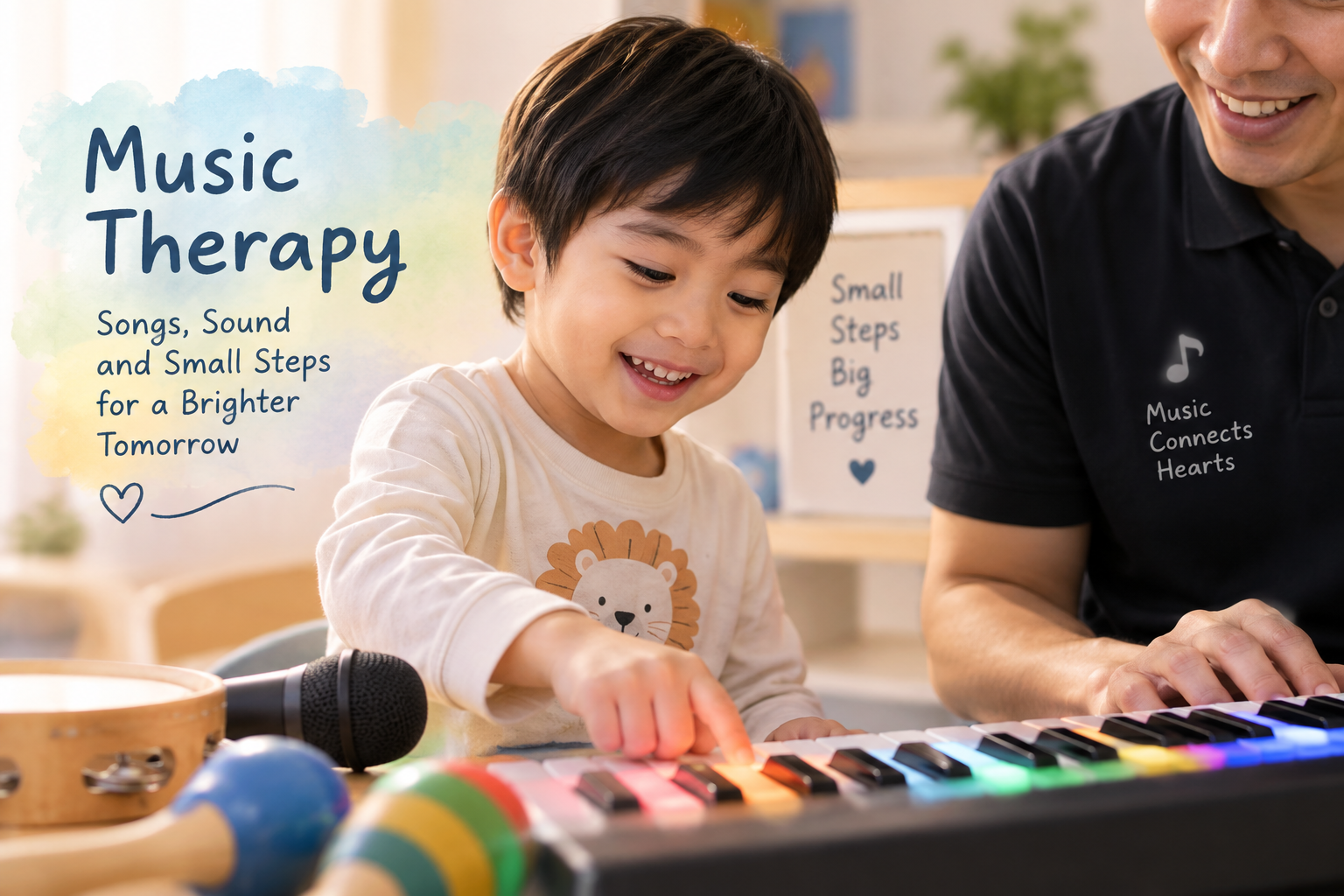
Music therapy was never something we had thought about.
In fact, when our son was little, music was something he mostly avoided.
He didn't like listening to songs unless they were part of the children's videos he already enjoyed watching. If a song suddenly came on television, he would often cover his ears. As he got older, instead of simply covering his ears, he sometimes walked over and switched the television off completely.
This continued until he was almost five.
During those years, I still tried introducing different things at home. I bought him small musical instruments to see whether anything would catch his interest.
Most of them didn't.
But he did like pressing the keys on a small piano.
He had always enjoyed pressing buttons and switches, so I think the piano keys appealed to him in a similar way. At the time, I didn't think much more of it.
Then one of my friends mentioned music therapy.
She sent me a few videos on YouTube showing what music therapy could look like for children.
That was really the first time I had properly thought about it.
What I expected at the beginning
My initial thought was very simple.
Maybe one day someone could teach him how to play the piano.
I also thought music therapy might help him concentrate on an activity for longer and perhaps support his regulation.
Looking back now, my understanding of music therapy was very limited.
I imagined sitting at a piano and learning notes.
What we actually experienced was much broader than that.
Music became a way to work on attention, communication, interaction, fine motor skills, regulation and eventually even language.
But at the beginning, we were a very long way from any of that.
The first sessions were difficult
When we started music therapy, I quickly realised how challenging many of the activities were for him.
Sitting down and following an activity was difficult.
He was easily distracted and constantly wanted to move around the room.
There were instruments everywhere, different objects to look at and new things to explore. Because everything was unfamiliar, his attention moved from one thing to another very quickly.
He wanted to investigate every instrument and every item in the room.
Following steps was difficult.
Waiting was difficult.
Staying with one activity was difficult.
There were sessions where he cried because everything became too much.
I always stayed with him during the sessions.
Most of the time, he sat on my lap. When he became distressed, I would hold him, give him a cuddle, reassure him and encourage him to try again when he was ready.
Sometimes a few hugs were enough for him to continue.
We weren't trying to force him to sit through something he couldn't cope with.
We were helping him feel safe enough to slowly try.
Progress came very slowly
Like many of the other therapies we have done, there wasn't one moment where everything suddenly changed.
He adjusted gradually.
Over time, there were sessions where he could stay with an activity without immediately getting up and walking around the room.
At first, even sitting for a few minutes was a goal.
Then those few minutes became longer.
That might sound like a very small achievement, but for us it was huge.
The sessions usually began with a hello song and finished with a goodbye song.
That predictable structure became familiar to him.
In between, we worked on many different things.
Some of the early goals were simply:
- staying with an activity for a little longer
- improving concentration
- parallel play
- interacting with another person
- building vocabulary
- encouraging speech
- following simple directions
When we began music therapy, Romeo was still almost non-verbal.
He couldn't say his therapist's name.
Many longer words were extremely difficult for him, and he often couldn't complete three-syllable words.
Looking back at those early sessions compared with where he is now feels like looking at two completely different stages of his life.
Learning through the piano
About a year into music therapy, the piano became a much more structured activity.
We started using coloured dots.
The keys were marked with different colours, and he would be asked to press the matching coloured keys one at a time.
At first, the goal was simply to use one finger and press the correct key.
Once he became comfortable with that, we slowly introduced using two fingers.
Then three.
Later, we moved to a keyboard where the keys light up in sequence with the rhythm of the music.
He watches for the glowing key and presses it to follow the tune.
We are still working on this now.
For him, it isn't just about learning to play music.
It requires him to watch carefully, concentrate, coordinate his fingers and stay with the activity.
It has become a wonderful exercise for both concentration and fine motor skills.
And when I think back to the little boy who couldn't stay seated for an activity, seeing him follow glowing piano keys feels very special.
Using music to build communication
As his language developed, the activities changed with him.
One of the things we are currently working on is answering questions.
For a long time, Romeo would often repeat what someone said rather than answering the question.
If we asked him something, he might mimic the words instead of understanding what information we were asking for.
So again, we had to go slowly.
We are now working on concepts such as:
Who?
When?
Why?
These are still difficult for him.
But the fact that we can now work on questions like these shows how far his communication has developed.
When he first started music therapy, we were working on individual words.
Now we can work on understanding questions and forming answers.
Music and regulation
Music therapy has also helped us introduce different ways of regulating.
One of those has been deep breathing.
This didn't happen immediately either.
We slowly helped him understand the idea of taking a deep breath and using breathing to calm his body when he was becoming overwhelmed.
Like everything else, it took repetition and patience.
One of my favourite moments
One of my proudest moments happens during the goodbye song.
Romeo gets to choose an instrument.
And sometimes he chooses the microphone.
He holds it and sings the goodbye song together with his therapist, in his own way.
For some families, a child singing into a microphone might seem like an ordinary moment.
For us, it isn't.
This is a child who once covered his ears when songs came on television.
A child who would switch the television off because he didn't want to hear music.
A child who was almost non-verbal when he began therapy.
Now he sometimes chooses a microphone.
And he sings.
Those are the moments that remind me why I try not to judge progress by how quickly it happens.
More than a year of small steps
None of these changes happened within a few weeks.
They took more than a year.
There were difficult sessions.
There were tears.
There were activities he didn't understand.
There were activities he didn't want to do.
There were many moments where the goal was simply to sit for another minute, try one more time or complete one small step.
But those small steps kept adding up.
He went from struggling to pronounce words to being able to use short sentences such as:
“I want...”
and
“Can I have this please?”
His communication has grown far beyond what it was when we walked into those first music therapy sessions.
Music therapy wasn't responsible for everything. His progress has come from years of support, therapy, learning at home and his own incredible effort.
But music therapy became an important part of that journey.
The relationship mattered too
I also have to thank his music therapist, Jeremy Yau.
He has been amazing with Romeo from the very beginning.
Romeo bonded with him very quickly.
That connection mattered.
Even when Romeo found an activity difficult or became frustrated, he still looked forward to his music therapy sessions.
Having someone who understood when to encourage him, when to slow things down and when to give him time made a huge difference.
As a parent, I was also always there beside him.
I think those sessions worked because he felt supported rather than pressured.
Looking back
If someone had told me years ago that the little boy covering his ears when music played would one day pick up a microphone and sing with his music therapist, I probably wouldn't have believed them.
When we started, I thought music therapy might eventually teach him to play the piano.
Instead, it became part of something much bigger.
It helped us work on attention.
Interaction.
Communication.
Fine motor skills.
Regulation.
Language.
Confidence.
And most importantly, connection.
We are still working on many of these things.
He still finds some activities difficult.
He still needs support.
But that doesn't take anything away from how far he has come.
Sometimes progress doesn't look like a huge milestone.
Sometimes it is sitting for two minutes instead of thirty seconds.
Pressing the correct coloured key.
Answering one question.
Taking a deep breath.
Saying a longer sentence.
Or choosing a microphone and singing goodbye.
For us, those small moments have become some of the biggest ones.

Small steps can become the biggest moments.
Music gave us another way to practise, communicate, regulate and connect — patiently, one moment at a time.