
♥ SPEECH THERAPY
Speech Therapy Was Not Just About Words
Our journey from complete non-verbal to meaningful communication, and the small steps that made the biggest difference.
 By Parenting EssentialsJune 24, 20265 min read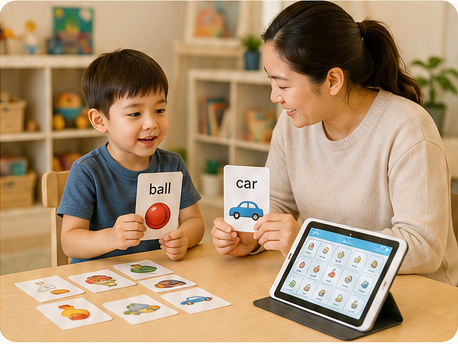
When we started speech therapy, my son was completely non-verbal.
His first word was "up." He loved Kinder Surprise, and I used to keep it on the top shelf. One day, he learned to say "up" because he wanted me to lift him or get it for him.
It was such a small word, but for us, it meant so much.
At the time, he was close to three years old. In the early speech therapy sessions, things were not easy. For a long time, he was mostly agitated during the sessions. He did not respond much to the therapist. If he was playing with something and someone sat next to him, he would often turn the other way.
He did not like other people touching the toys or items he was playing with. He cried a lot during sessions. Many times, it felt like we were not achieving anything.
I could not see clear progress in his verbal communication, and that was very hard. But at some point, I slowly started to understand something important.
Just because he was not responding did not mean he was not listening. Just because he was not speaking did not mean he was not understanding. Just because he was quiet did not mean he was not absorbing what was happening around him.
So even when he did not respond, I continued talking to him. During our usual walks, I would carry him and point out things around us: green tree, big truck, red car, bird, dog.
Most of the time, there was no response. Sometimes there was no reaction at all. But I kept going.
I also joined autism parent communities online. I would read posts from other parents whose children started talking at five, six, or even eight years old. Those stories gave me hope, but they also made me worried.
I wondered if we would ever hear him say "mom" or "dad." That fear is hard to explain unless you have lived it.
Over time, another realisation became very important for us. Speech therapy was not only about talking. It was about communication.
It was more important for him to be able to communicate his needs than to simply say words clearly.
A gentle reminder
Every child is unique. What worked for our son may look different for yours. Trust your child, trust the process, and be kind to yourself.

What our speech therapy journey looked like

1 We thought speech therapy was only about talking
At first, we thought the goal was to teach words. We later learned communication is so much bigger.

2 The first sessions were about connection and trust
He was often upset, did not respond, and turned away. Building trust took time, and that was okay.

3 Play became the main way to encourage communication
Toys, bubbles, books and songs helped him stay engaged and naturally encouraged interaction.

4 We learned to wait and give him time to respond
Pausing, waiting and not rushing gave him the space to think and respond in his own time.

5 Choices helped him communicate
Simple choices and offering two options helped him express what he wanted or needed.

6 Gestures, sounds and pointing mattered too
Sign language, sounds, pointing, and body language were all powerful ways for him to communicate.

7 Sign language and Proloquo helped bridge communication
We used simple signs and the Proloquo app on the iPad while continuing to model speech. They gave him another way to communicate before clear words came.

8 Repeating small strategies at home made a difference
What we practised at home, in daily life, helped him feel confident and consistent.

9 Progress was slow, but every small step mattered
Every sound, word, sign, or attempt was a big win worth celebrating.
We started with sign language and an iPad communication app
One important shift for us was understanding that speech therapy was not only about making him say words. Before clear speech came, he still needed a way to communicate his needs.
So we started working on simple sign language while continuing to model speech. We used signs for common things he wanted or needed, and we said the word at the same time.
The goal was not to replace speech. The goal was to give him another way to communicate while speech was still developing.
We also used the Proloquo app on the iPad to model words and help him ask for things.
At first, I worried that using signs or an iPad might stop him from talking. But over time, I understood that communication support does not take speech away. It gives the child a way to express themselves while they are still learning.
Using signs and the iPad helped us reduce some frustration because he did not always have to cry, guess, or pull us toward something. He had more ways to tell us what he wanted.
We kept modelling speech alongside everything. If he used a sign, we said the word. If he used the app, we said the word. If he made a sound or used his own version of a word, we responded and expanded it.
Slowly, those small communication attempts became more meaningful. Looking back, sign language and the communication app were not a step away from speech. They were part of the bridge toward it.
As he slowly started communicating verbally, his speech was not clear at first. He used his own words for things. He would say "do doi" for Kinder Surprise, "ta" for gumballs, and "wa wa" for watermelon.
They were not perfect words, but they were his words. And we understood what he meant.
Then, slowly, he started saying "daddy" and "mom." I cannot properly describe that feeling.
When he joined school at six, he still could not say his own name clearly. I remember, after a few terms, dropping him at school and telling his teacher, "Now he can say his name." That was such a big moment for us.
In the beginning, when he first started communicating verbally, his voice was shaky and unclear. I taught him a small song verse, and hearing him sing it was amazing.
There were many ordinary moments that I now realise mattered. Before bedtime, whether he responded or not, we would tell him bedtime stories, sing songs, and talk about the day.
At the time, it was easy to think maybe none of it was going in. But it was. He was absorbing more than we realised. It just took him time to become comfortable enough to show us.
Looking back, speech therapy taught me that communication can start long before clear words. It can start with a look, a sound, a gesture, a sign, a made-up word, a child pulling your hand, or a child slowly finding their own way to tell you something.
If your child is not speaking yet, I know how painful and worrying that wait can feel. Keep talking. Keep modelling. Keep giving them ways to communicate. Keep noticing the small attempts.
For us, speech therapy was not just about teaching words. It was about helping our son find his voice, in his own time.

Communication can start long before clear words.
Speech therapy taught us that connection, patience, and understanding our son's unique way of communicating made all the difference.
Keep going. You're doing better than you think.


