
What 2-Year-Olds Learn Through Play
Two-year-olds learn through doing. They carry things, sort things, knock towers down, copy adults, ask for the same book again, and turn an empty box into something deeply important. It can look simple from the outside, but a lot is happening underneath.
The Short Version
At age two, play is not a break from learning. It is the way toddlers practice language, movement, problem solving, imitation, social confidence, and independence. The best activities are usually simple, repeatable, safe, and easy for a child to explore without constant adult instruction.
What Two-Year-Olds Are Practicing During Play
Why Simple Toys Often Work Better Than Busy Toys
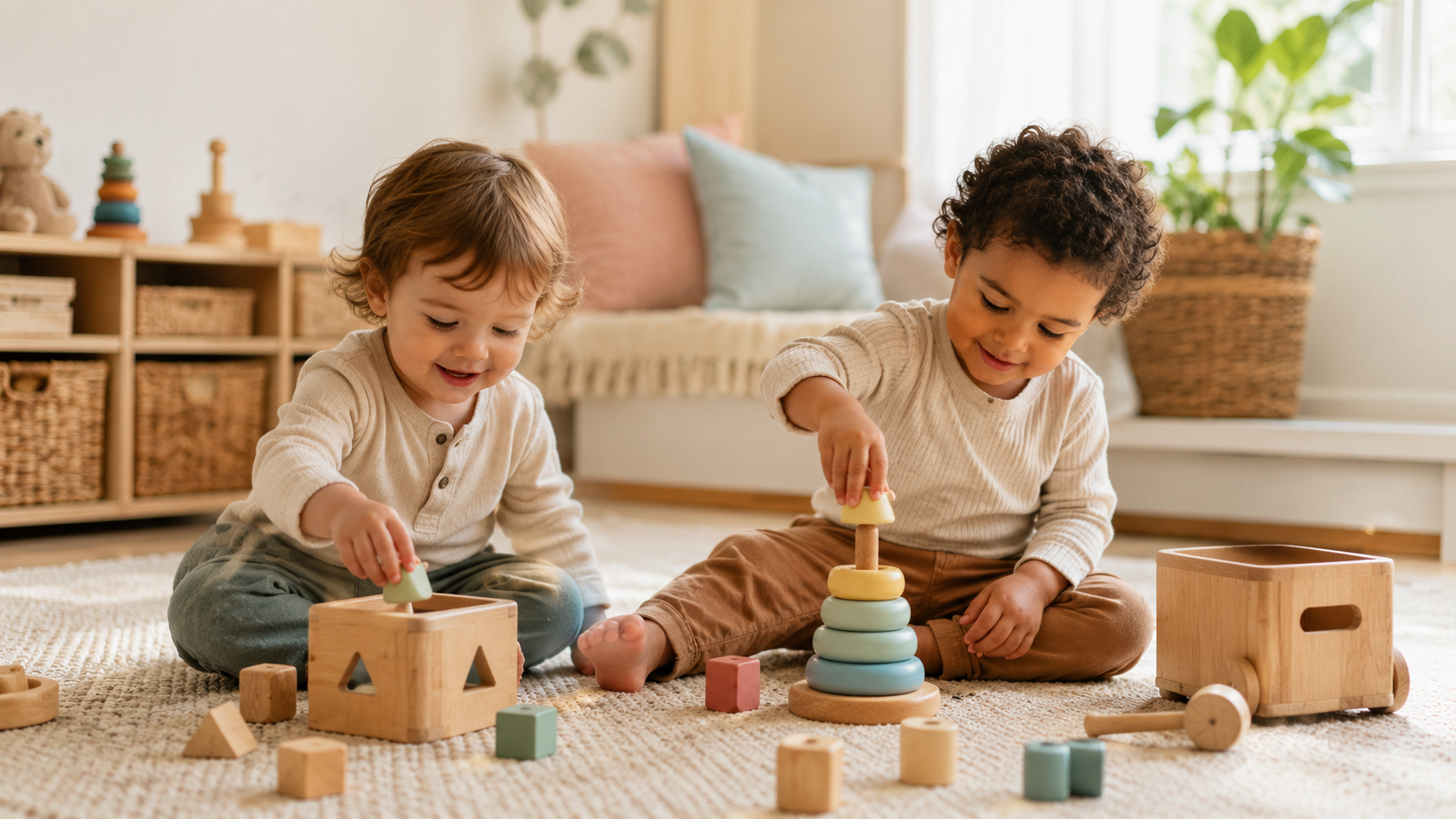
A toy does not need flashing lights or a long list of features to be educational. For a two-year-old, the best play often leaves room for the child to decide what happens next. Blocks can become a road. Pretend food can become a picnic. A shape sorter can become a counting game, a color game, or a dump-and-fill activity.
That flexibility matters because toddlers are still learning how to stay with a task. A toy that does one loud thing can become boring quickly. A toy that can be used in several ways gives the child more chances to practice, repeat, and invent.
Helpful Types of Play for Two-Year-Olds
Sorting and Matching
Sorting toys, shape sorters, color games, and simple puzzles help toddlers notice differences. You can keep the language simple: big, small, red, blue, same, different, in, out.
Pretend Play
Pretend play is where toddlers rehearse real life. A toy kitchen, play food, baby doll, small animals, or dress-up scarf can lead to rich language without feeling like a lesson.
Building and Knocking Down
Stacking blocks and magnetic tiles support balance, cause and effect, early spatial thinking, and persistence. Knocking the tower down is part of the experiment, not a failure.
Movement Play
Push toys, soft obstacle courses, dancing, and outdoor play help toddlers build coordination and confidence. Movement also helps many children settle into quieter activities afterward.
How Parents Can Join Without Taking Over
- Describe what your child is doing instead of turning everything into a quiz.
- Offer two simple choices when they seem stuck.
- Use short phrases they can copy: "big tower," "red apple," "my turn."
- Pause long enough for them to respond, even if the response is a gesture.
- Let repetition happen. Repeating the same activity is often how toddlers master it.
What To Avoid Overdoing
Try not to turn every play session into a lesson. Two-year-olds learn best when they feel safe, curious, and free to test ideas. Too many questions, too much correction, or too many toys at once can make play feel harder than it needs to be.
A smaller toy rotation is usually easier for toddlers to use well. A few open-ended options, a familiar puzzle, a pretend play item, and something for movement can go a long way.
Research & Further Reading
These sources support the developmental ideas behind the play examples in this guide.
FAQ
What should a 2-year-old learn through play?
A two-year-old learns language, imitation, problem solving, balance, fine motor control, emotional practice, and early independence through everyday play.
Do 2-year-olds need academic toys?
Most two-year-olds do not need formal academic toys. Simple hands-on play, naming, sorting, pretend routines, movement, and puzzles usually matter more.
How long should a 2-year-old play independently?
Independent play varies a lot. Short stretches of five to fifteen minutes are normal for many toddlers, especially when the activity is familiar and safe.
How can parents support toddler learning without over-teaching?
Use simple words, describe what the child is doing, offer choices, pause for them to respond, and let the play stay playful.