
♥ PHYSIOTHERAPY
Physiotherapy: Building Strength, Balance and Confidence
Our journey through core strength, balance, coordination and movement, one small step at a time.
 By Parenting EssentialsJune 30, 20266 min read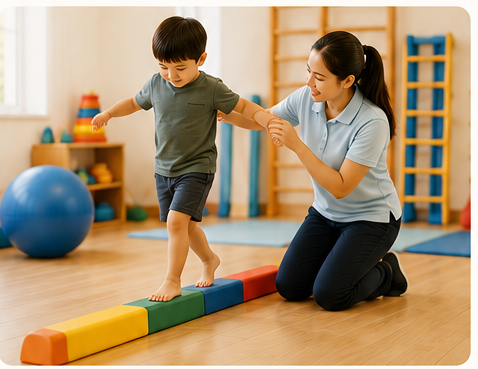
Physiotherapy became an important part of our son's therapy journey a few months after we started speech therapy and occupational therapy.
At first, I did not fully understand why he needed physio. But over time, it started to make a lot of sense.
He had weak core strength, poor balance, difficulty with coordination, and delays with gross motor skills. Everyday movements that looked simple from the outside took a lot of effort for him.
He could not walk steadily on a balance beam, even when it was wide and close to the ground. Throwing, catching, jumping, hopping, climbing, and moving his body with confidence all took time. On stairs, he crawled for a long period before he was ready to walk up properly.
Physio was slow, steady work.
Because of his weak core strength, many activities tired him quickly. We initially had one-hour physio sessions every week, but that was too much for him at the start. We reduced the sessions to around 45 minutes so he could manage better and stay more engaged.
A gentle reminder
Every child is unique. What worked for our son may look different for yours. Trust your child, trust the process, and be kind to yourself.

What our physio journey looked like

1 Weak core strength made sessions tiring
Many activities tired him quickly. We reduced sessions from one hour to 45 minutes so he could manage better and enjoy more.

2 Balance beam took years
It may look simple, but it took balance, body awareness and confidence. He walked straight on a balance beam at around seven.

3 Stairs became a big milestone
He crawled up the stairs for a long time. Slowly he started holding the railing and walking up on his own.

4 Climbing needed confidence and motivation
He was scared of heights. We used his favourite cartoon on YouTube or snacks at the top to encourage him to take a few more steps.

5 Catching developed in tiny stages
He went from not lifting his hands, to using his body, to using his hands, and finally moving his hands to catch accurately.

6 Throwing became play with favourite characters
We used Talking Tom and Friends and Bluey stickers on the wall. Throwing at targets became more fun and less frustrating.

7 Jumping and hopping took years
We started with standing on one leg, used coloured insoles, and counted together. It took almost three years to jump a little.

8 Consistency with the same physio helped
We had the same physio for almost four years. She knew him well and built the right plan with patience and understanding.
Balance, stairs and climbing took time
In the beginning, we focused a lot on walking on a balance beam. It sounds like a small thing, but for him it required balance, body awareness, confidence, and control. He did not walk straight on a balance beam until he was around seven years old.
Stairs were another big milestone. For a long time, he crawled up the steps. Then slowly, he started holding the railing and walking up. That was a huge moment for us.
Climbing was another area where he needed a lot of support. He was scared of heights, and that made climbing even harder for him. We had to come up with small ways to encourage him without pushing him too far.
Sometimes I would play his favourite cartoon on YouTube and place it near the top of the ladder. Other times, we used his favourite snacks as motivation.
He still did not go all the way to the top straight away, but it encouraged him to take a few more steps than before. For us, that mattered.
The goal was not to force him to climb all the way up. The goal was to help him feel safe enough to try one step more.
Catching and throwing came in tiny stages
Catching was a skill that developed in tiny stages.
At first, he would not even lift his hands when something was thrown toward him. Then he randomly started lifting his hands, but he had no awareness of where the object was going. Slowly, he began using his body to catch. Then, over time, he started using his hands. Later, he even began moving his hands a little to catch more accurately.
Those stages may sound small, but for us they were real milestones.
Throwing also took a long time to build. In the beginning, he could not throw even one metre away. Even now, throwing is still something we continue to work on, but he tries, aims at nearby objects, and understands the purpose of the activity much better.
One activity we worked on was throwing at a target on the wall. At first, he became frustrated when he missed, and he missed a lot.
So we changed the activity to make it more fun. We added Talking Tom and Friends stickers one by one on the wall. Later, we also used the Bluey family. Because he liked the characters, he became more interested and tried for longer.
That small change made the activity feel less like a task and more like play.
Eventually, we moved on to throwing and catching. He had to throw the ball at the wall, hit the target, and then catch the rebound ball. The wall was only about one metre away, but the timing and coordination needed for that activity took a long time to develop.
But eventually, he mastered it.
Then one day, he surprised us even more. He pulled out the balance board, balanced himself on it, and started throwing and catching without falling down. That moment was amazing.
Jumping and hopping took years
Jumping was another skill that took years of practice.
We started by working on standing on one leg. To help him, we used coloured insoles where he could place his feet. That gave him a visual guide and helped him understand where to stand.
Counting together also helped.
It took almost three years before he could finally jump a little bit. He still struggles to jump properly, but even that small jump was big progress for us.
After that, we worked on hopping. Hopping needed strength, balance, timing, confidence, and coordination all at once, so it took a lot of practice.
All these milestones took years. But I am so proud of the effort he put in.
Consistency helped us build slowly
One thing that helped a lot was consistency.
We had the same physiotherapist for almost four years, and that made a big difference. Because the physio knew him well, she understood what he could manage, what frustrated him, what motivated him, and how to slowly build goals over time.
Looking back, physiotherapy was not about quick progress. It was about tiny steps repeated again and again.
It was about strength, balance, coordination, confidence, and helping him feel more capable in his body.
Some milestones took months. Some took years. But every small improvement mattered.
If your child is working on movement, balance, jumping, catching, stairs or coordination, I know how slow it can feel. Sometimes it looks like nothing is changing.
But progress can be happening quietly. One day, your child may do something you have practised for years, and suddenly all those small efforts feel worth it.

Progress looks different for every child.
Physio taught us that small steps, patience and consistency help our child feel stronger, more confident and proud of what their body can do.
Keep going. You're doing better than you think.